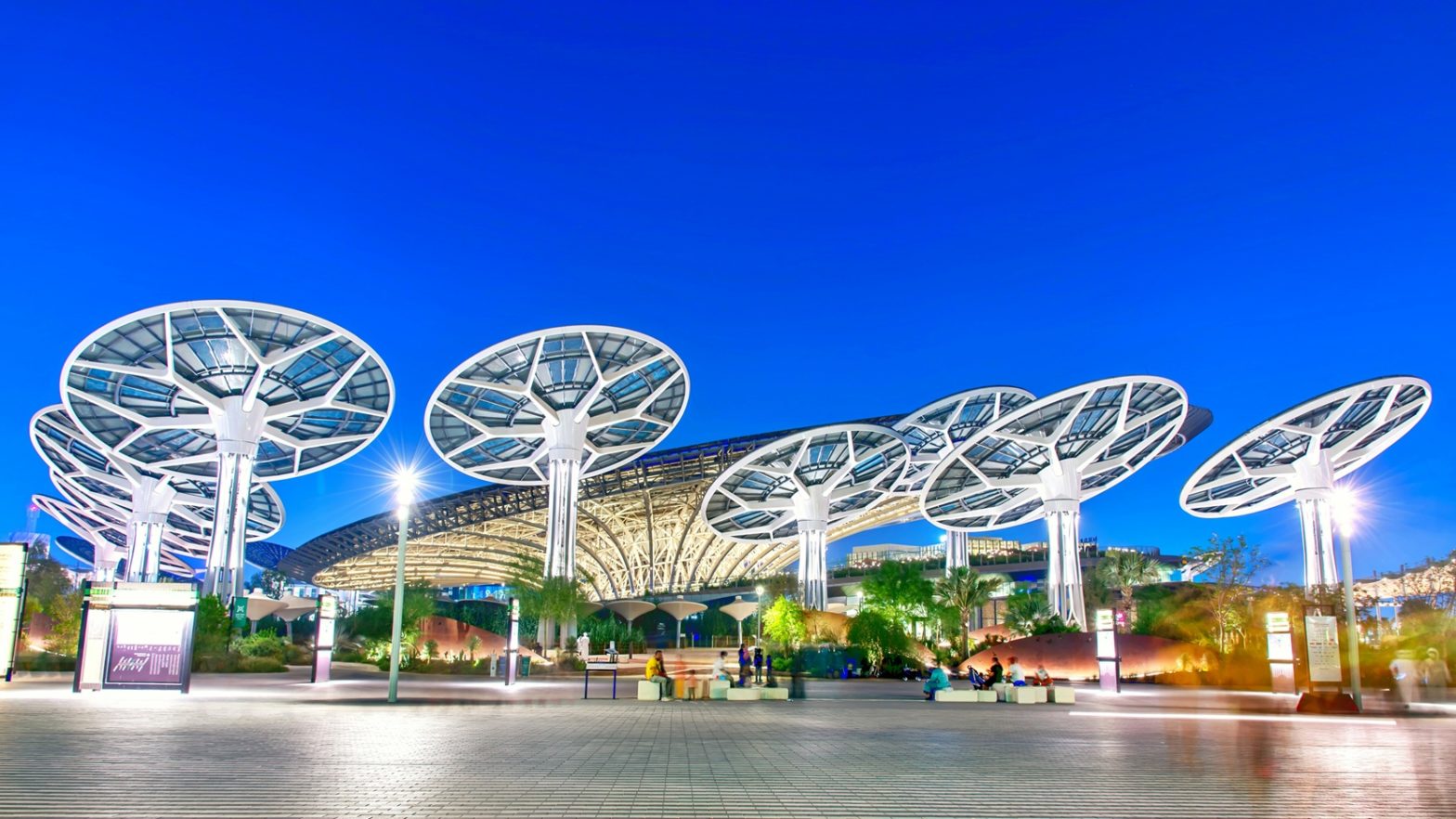
Photo: SHUXIN WU | Unsplash
From World Expos to World Cups: what a city keeps after the crowds go home
02 July 2026
By Nadia Verjee, Executive Director of Expo City Dubai, Global Initiatives and Advisory.
Right now, in Los Angeles, transport planners are making decisions about rail capacity that will shape how the city moves for the next 50 years. The trigger was the 2026 World Cup. But the investment logic runs further, to the 2028 Summer Olympics, when those same lines will carry different visitors to different venues. Two events, one infrastructure thesis. That is the correct way to read them, and it is how the planners are reading them.
Los Angeles is not alone. Over the next six years a Winter Olympics, an Asian Games and another World Cup will move tens of billions of dollars into the ground. Much of it will keep delivering long after the broadcast trucks have left.

The cost of a mega-event is the part everyone reports, especially when ticket sales, hotel occupancy, broadcast rights and visitor spending land below the projections. The part that goes unwritten is what the event leaves behind.
Consider the numbers attached to 2026. More than US$4 billion in combined infrastructure investment across the host cities of the US, Canada and Mexico. New York and New Jersey alone anticipate an economic impact above US$3.3 billion. That figure is not football fans buying dinner. It is permanent transport upgrades, terminal expansions and urban mobility that will serve those two states for decades after the final whistle.
This is the distinction at the centre of the legacy question, and it is the distinction we examined in a white paper produced by UN-Habitat and Expo City Dubai. Looking across two decades of mega-events, we found that the conversion of immediate impact into enduring growth turns on governance, not scale. Success depends on deep community integration and on a legacy blueprint drawn before the bidding even begins.
A won bid forces a decision cycle that ordinary governance would struggle to produce. It creates a mandate. It draws in global capital and expertise on a timeline faster than incremental policy allows. It gives a government the room to make investments that were needed for decades and deferred for just as long. The deadline does the work that political will, on its own, rarely manages.
That logic is now shaping what comes next. Brisbane, with the 2032 Olympics, using the Games to reshape the urban fabric of South-East Queensland. The decisions that will define Brisbane for the next half century are being made now, six years before the torch is lit, under a pressure that only a committed deadline creates.
I know this sequence from the inside as part of the core team at Expo 2020 Dubai, and our legacy planning began at day zero. We asked whether pavilions built for six months could become places of work. Whether a site designed around visitor flows could hold a neighbourhood. Whether infrastructure built to serve millions over half a year could sustain tens of thousands over decades.
We made sure the answer was yes. Eighty percent of the infrastructure built for Expo 2020 now serves Expo City Dubai, the legacy city of the World Expo and a hub in the Dubai 2040 Urban Master Plan. The Dubai Exhibition Centre anchors major business events. Parks, restaurants, offices, educational assets and district infrastructure, soon joined by residential communities, are connected through shaded walkways and mobility links. The foundations of a working city. Every one of those features was written into the founding vision, long before the first shovel broke ground.
The numbers followed the planning. An EY report projected Expo 2020 would add US$42.2 billion to the UAE economy within a decade. Brand Finance placed the UAE in the top ten of its soft power index for the first time, a direct result of the World Expo. Both outcomes of a bid process that carried legacy inside it from the start.
The cities preparing for future events have more evidence in front of them than any generation of hosts before them. They can see what worked and what failed in cities across the world. That is what the white paper gives them, a framework for turning evidence into practice. An introductory manual for hosts who would rather be remembered for housing, connectivity and opportunity than for a ribbon-cutting.
The choice between a city left better off and a city left worse off is an economic one. And it is made before the bid is ever submitted.