
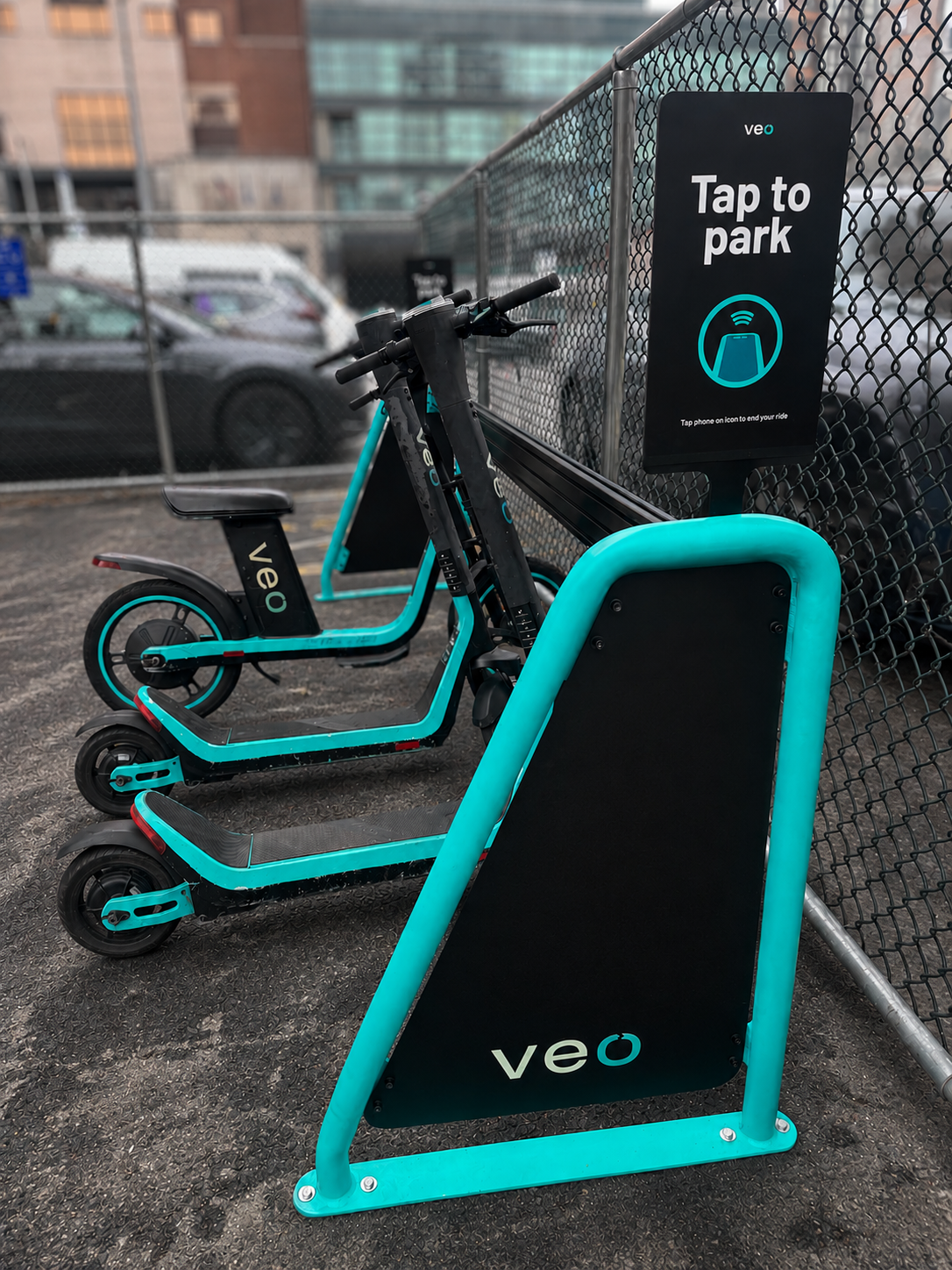
Veo to expand tap-to-park corrals
23 July 2026
by Jonathan Andrews
Veo is preparing to expand its new tap-to-park micromobility system to hundreds of corrals, offering cities an alternative to conventional docking stations and GPS-based parking controls.
The technology has made its debut in Queens, New York City, with further installations planned in Santa Monica and Denver this summer. Veo describes the corrals as the first of their kind and expects them to spread rapidly to other North American cities.
When riders enter a mandatory parking zone, the Veo app directs them to a nearby corral. Instead of relying on GPS to confirm their location or requiring a vacant physical dock, they end the journey by tapping their phone against an NFC-enabled kiosk.

“You get 99 percent of the benefits of a dock-based system, but with a lot more flexibility on installation and, frankly, a little bit more flexibility for the rider,” Alex Keating, Vice President, Policy and Partnerships, Veo, told Cities Today.
The corrals use NFC technology and lightweight racks to organise vehicles within a designated area, rather than assigning each bicycle or scooter an individual docking point. Keating said this makes the model highly transferable, allowing municipalities to adapt it to their own street layouts, parking rules and kerb-management needs, particularly in dense areas where orderly parking is most important.
The system also addresses GPS drift, which can prevent riders from ending a journey even when they are standing inside an approved parking area. Veo said tapping a phone provides more precise confirmation while using an action already familiar from contactless payments.
“The feedback we’ve gotten from riders is that they understand how to do it, and it’s not a technology that adds additional time,” Keating said. “It actually makes their end-of-trip process more smooth.”
Veo’s 2025 rider survey found that 57 percent of respondents always, often or sometimes had trouble finding somewhere suitable to park.
Keating said the technology could support a hybrid model in which tap-to-park corrals become mandatory in dense city centres, while riders in lower-density areas continue to leave vehicles responsibly in designated pavement furniture or amenity zones.
The operator expects designated corrals to become a standard element of urban transport infrastructure. Cities could place them in former kerbside parking spaces, including near daylighted intersections– where car parking is removed close to the corner or pedestrian crossing–, to support clearer pavements and improve visibility.
“Most people want to do the right thing,” Keating said. “We just have to provide them the space and the workflow or technology that makes it intuitive and easy.”
Images: Veo