
Q&A: The story behind Raleigh’s “Office of yes, and!”
23 February 2026
By Chelsea McCullough, Smart Cities Connect
Q&A with Dr. Heather McDougall, Strategy & Innovation Officer, Office of Strategy and Innovation
A few weeks ago, we shared information about how the City of Raleigh’s Office of Strategy and Innovation team has built a strategic practice of strategic technology design and deployment that centers on resident engagement and community insights. What they have accomplished as a team of human-centred designers and innovators inspires us to learn more about how they did it and what lies ahead. I’m thrilled to speak with Dr Heather McDougall, Strategy & Innovation Officer, to learn more:
CM: Can you tell us a bit about the history of the department and how this all came together?
HM: The Office of Strategy & Innovation [we prefer to call ourselves the Office of yes, and!] was created in 2021 and was the vision of former Mayor Mary-Ann Baldwin and current City Manager Marchell Adams-David to create a greater focus on innovation and a bridge between the innovation ecosystem and the city. Given the great uncertainty of 2021 and COVID, the city could have easily put a pause on this initiative. I think it was courageous leadership to move forward.
CM: Your human-centred design approach is inspiring. How do you ‘bring people along’ who may not be familiar with this approach? (In other words, how do you handle communication and collaboration with those who may not initially adapt your approach?)
HM: We are a small team of optimists who are highly collaborative. Many of our team members come from the social innovation realm and for us there is a natural connection between innovation and public good. Human-centred design, a key tool of social innovation, is about putting people first, which directly aligns with the mission of the public sector. Our team has been good about articulating this natural connection and getting staff excited to see themselves and their work in the methodologies.
CM: With so many accomplishments and ground-breaking programmes, I have to admit you make it look easy. I’m sure there were some bumps along the way. What lessons learned can you share with us?
HM: There is a misconception that local government is not innovative. It’s been a pleasure to see how innovation flows throughout the departments and staff. Our team has been very intentional to build relationships at all levels of the organisation and to champion and showcase the innovation that already exists. Looking back, this was the most important investment we could have made.
My team jokes that our superpowers of resilience, unapologetic optimism, and ability to keep powering forward can also be our kryptonite–we often want to take on more projects than are humanly possible! We took the time to bring in an emotional intelligence coach who helped us better understand these superpowers and better structure our projects to ensure we could maximise impact but not burn ourselves out! It was crucial to make the investment in our team to ensure we could best serve the city.
Being able to mature our structure and processes for smart city projects has been an important part of our journey. There is a natural tendency to take on numerous pilots at one time. We’ve had to stop, reflect, and hone. From this reflective process, we’re implementing a phased approach: Phase 1: Understand Needs & Opportunities. Phase 2: Small-Scale Testing with Room to Think Big! Phase 3: Embed/Scale!
Utilising our strengths in human-centred design, this phased approach puts a large emphasis on pre-pilot discovery to ensure we fully understand the residents’ and departments’ needs prior to deploying and testing the technology.
CM: What do you think is the biggest opportunity for city-based innovation (and/or smart cities) in 2025?
HM: Our team is integrating Strategic Foresight into our projects. We just finished a Big Ideas Report evaluating 10 possible ideas for council to advance Sponge Cities, Affordable Housing, and Multi-Modal Transit. We grounded the project in the principle that in order to imagine meaningful, relevant Big Ideas, we must use strategic foresight to look to the future and consider the ways the world is changing so that we build solutions that meet the needs of future Raleighites.
Strategic foresight involves: exploring different potential futures to anticipate what might happen; identifying major trends (megatrends), such as environmental challenges, new technologies, and shifts in population; developing strong, flexible strategies to manage long-term challenges; and enabling proactive decision-making which helps build sustainable, fair, and adaptable cities for everyone. Strategic Foresight pairs extremely well with human-centred design and helps to assess the desirability, viability, and feasibility of projects.
CM: What do you think is/are the biggest obstacles for city-based innovation (and/or smart cities) in 2025?
HM: Most cities are facing financial challenges and having to make tough decisions on which programs/projects to prioritise. Fortunately local governments are great at powering through and remaining laser focused on residents. But it does mean they have to be more resourceful and find ways to build new partnerships. This makes the partnership with industry even more important.
CM: What plans are underway in your department? What are the goals for 2026?
HM: Our team recently redesigned and launched the city’s new Strategic Plan. At the City of Raleigh we approach strategic planning not as the creation of a document but rather as a vibrant and actionable process that transforms city strategy into collaborative and measurable impact. The FY26-29 City of Raleigh Strategic Plan is built for action and designed with people in mind. It is a new model of strategic planning that our national and international local governments can learn from. The plan’s structure and new framework are the result of a year-long human centered design process where the Office of Strategy & Innovation (OSI) engaged with residents, staff, City Council, and City Manager’s Office to co-create priorities and potential solutions. The plan is rolled out through a phased implementation model that gives clarity on the issue, provides data-driven insights, and the space to test and pilot ideas. Phase 1: Understand Needs & Opportunities. Phase 2: Small-Scale Testing with Room to Think Big! Phase 3: Embed/Scale!
We will be rolling out this model in our Smart Raleigh programme. Yes this is a robust and highly intentional process but it allows our Smart Raleigh programme to have a clear focus, be deeply connected to resident and department needs, and allow the city to make data-driven decisions on which technologies to embed/scale.
CM: How do you manage projects and partnerships with industry? What can they expect when they express a desire to work with the City of Raleigh (and engage with OSI)?
HM: Raleigh received the 2025 Milken Best-Performing Large Cities designation due to our vibrant innovation community, thriving workforce, and our resilience as a community. These are key ingredients for future innovation and we are fortunate to have so many start-ups and tech companies to potentially work with. The key for partnerships with industry is a clear linkage to city priorities and the guiding principle: People First, Technology Second. How will this project/pilot make a significant impact on the community? How will it allow the city to improve key services and residents’ lives? I’d encourage industry to make sure it is familiar with the city’s top priorities–a city’s Strategic Plan is a great start. This helps to ensure the technology is serving a challenge the city has identified and makes it easier for a department to understand why it should invest funds and staff on the pilot.
CM: Tell us about your journey to becoming a smart city leader? Did you always imagine being in this professional sector?
HM: My path is a bit unique. I’m a political philosopher by training who was on the path to becoming a leadership studies professor when I had a “moment of obligation” to create the first leadership study abroad program. I had the pleasure of building the program from scratch, taking it from a 10-person pilot program in Prague, Czech Republic to a social enterprise operated in 10 countries, hosting university students from 80 countries, and inspiring students to become future leaders and change agents. How is this related to smart cities? The beautiful thing about humanity is that there is something that drives us to continually improve ourselves and our community (for any fellow philosophy geeks the term is meliorism). Technology can be a wonderful tool to help us imagine and test new solutions. The challenge is to always keep it people-centered with a clear structure.
CM: If you could change one thing about the smart cities sector, what would that be? How would you influence the future?
HM: I’d like to see more service designers embedded in smart city programmes.
CM: What else should we know about the City of Raleigh and/or OSI?
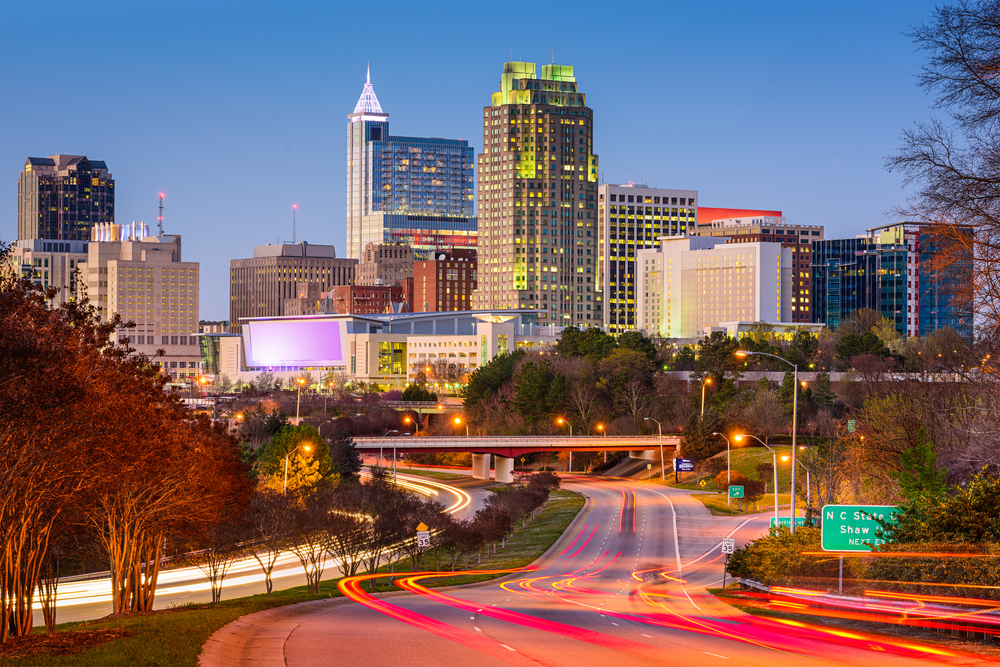
Raleigh is a hidden gem that has a vibrant innovation ecosystem that is highly collaborative. Be prepared that when you come to SCC in Raleigh, you might not want to leave.
Photo: Smart Cities Connect / Shutterstock 1307185885