
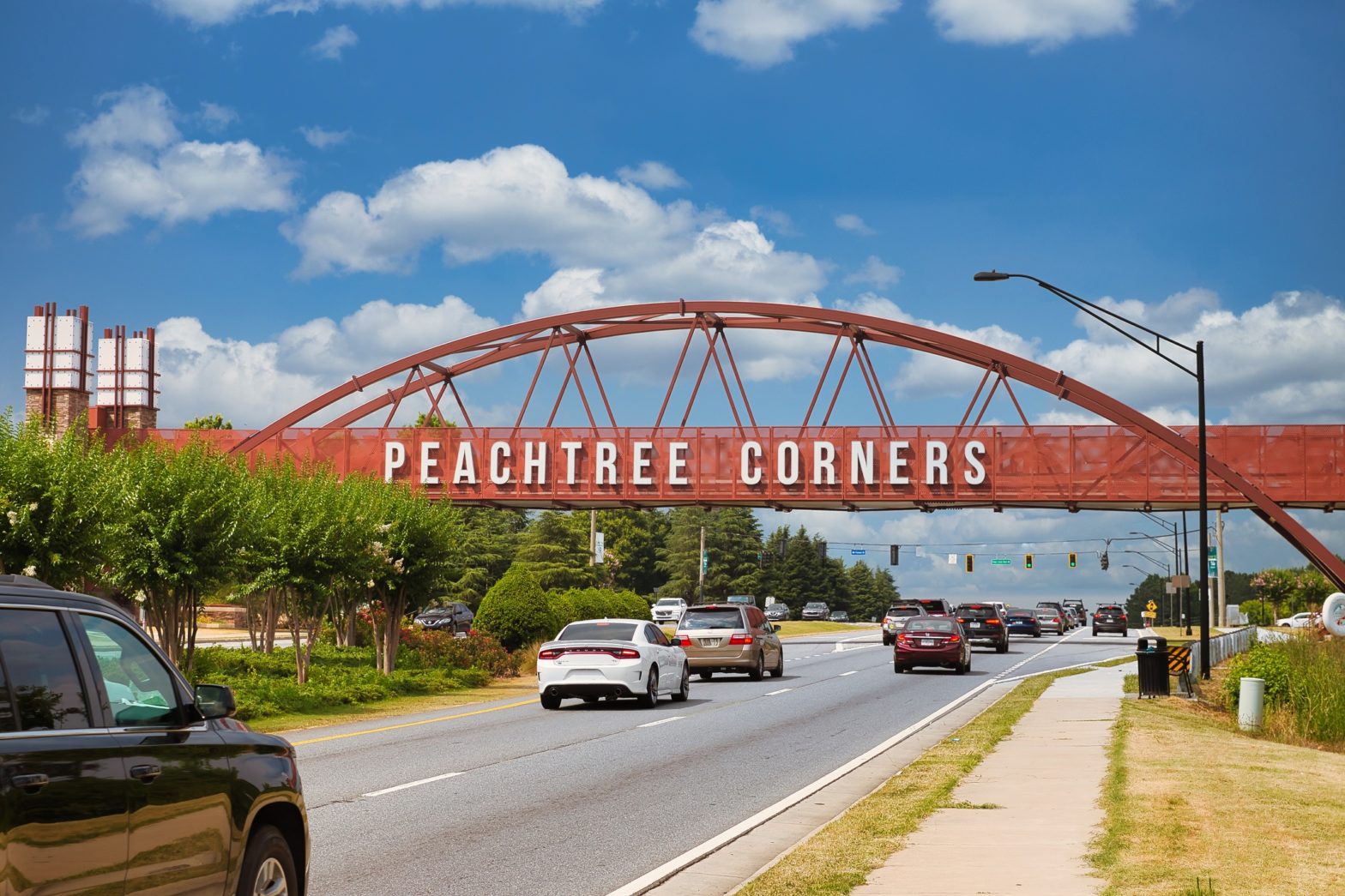
Peachtree Corners targets autonomous mobility commercialisation
08 July 2026
by Jonathan Andrews
Peachtree Corners has launched a funded programme offering up to US$250,000 for autonomous mobility companies to deploy and validate their technologies on public roads, as the Georgia city seeks to help bridge the gap between testing and commercial deployment.
The new Autonomous Mobility Program, run through Curiosity Lab, will provide between US$25,000 and US$250,000 to selected companies deploying technologies on the city’s nearly four-mile autonomous mobility route. Rather than offering another controlled testing environment, the initiative aims to help companies validate products under real operating conditions while building relationships with customers, partners and investors.
Speaking to Cities Today, Emily Heintz, Executive Director of Curiosity Lab, said many autonomous mobility companies have reached a stage where laboratory and proving-ground testing is no longer enough.

“Many companies are past the concept stage, but still need real-world places to validate, refine and prove their technology in conditions that actually look like the market,” she said. “That is the gap we are trying to help fill.”
Unlike traditional proving grounds, Curiosity Lab operates within an active commercial district, where autonomous systems encounter live traffic, pedestrians, business entrances, intersections and the unpredictability of everyday urban environments.
“We are a real city environment. Companies are not just testing whether something works in theory. They are validating how it performs around live traffic, intersections, sidewalks, driveways, buildings, tree coverage, pedestrians, businesses and the everyday complexity of an active commercial district,” Heintz explained.
The programme coincides with the completion of a year-long expansion of the city’s autonomous route, creating additional capacity for new deployments. Curiosity Lab is seeking applications from companies developing autonomous passenger shuttles, delivery vehicles, logistics platforms, robotic mobility systems and other technologies ready for real-world deployment or early scaling.
Heintz said the programme is looking beyond technology demonstrations towards practical urban applications.
“That might be hotel guest transportation, employee mobility, first-mile/last-mile service, food or supply delivery, autonomous connections between commercial destinations, pedestrian safety applications or robotic systems that help solve real mobility and logistics challenges,” she said.
Successful applicants will also be expected to demonstrate how their deployment could progress beyond a pilot.
“We want cutting-edge technology, but we also want a clear operating plan, a defined use case, a strong team and a thoughtful approach to safety, insurance, infrastructure and city approvals,” she said.
The autonomous route combines dedicated vehicle lanes with connected vehicle infrastructure, smart intersections, cameras, sensors, traffic monitoring systems and access to T-Mobile’s 5G network, allowing companies to evaluate technologies in conditions that closely resemble commercial operations.
Beyond validating technology, Curiosity Lab hopes the programme will encourage companies to establish a longer-term presence in the Atlanta region.
“From Curiosity Lab’s perspective, success also means some of these companies see Peachtree Corners as a place to keep growing,” Heintz said. “That could mean establishing a presence at Curiosity Lab, spending more time in the market, building partnerships in metro Atlanta with OEMs, automotive companies, logistics partners, infrastructure companies or public-sector stakeholders, or using the deployment as a launch point for broader US growth.”
She said the initiative also reflects a wider role for cities in supporting innovation beyond the pilot phase.
“We also want the programme to reinforce a bigger message: cities have an important role to play in helping emerging technologies move from pilot to practical use,” she said. “The ideal outcome is that Peachtree Corners continues to be known as a place where autonomous mobility is not just demonstrated, but thoughtfully deployed, tested, validated and scaled in real-world city conditions.”
Main image: Marlon Brathwaite | Dreamstime.com