
Can cities put freight on public transport?
16 September 2026
by Jonathan Andrews
Researchers are examining whether spare capacity on buses, trams and trains could help cities reduce delivery traffic, but turning the concept into a workable network will require difficult operational and policy decisions.
Public transport networks could assume a second role in urban mobility by carrying parcels into congested city centres, reducing the number of delivery vans competing for limited road space.
Known as Freight-on-Transit, the concept involves taking parcels from distribution facilities to selected public transport stops on the outskirts of a city. They then travel by bus, tram or train before being collected at another stop for delivery by cargo bike, another small vehicle or a courier on foot.
Interest in the approach is being driven by the rapid growth of online shopping, particularly since the COVID-19 pandemic.

“E-commerce has become an everyday thing for everybody, so we learnt that we can just click and buy, and we will have the item delivered to us almost instantly,” Diego Delle Donne, Assistant Professor at ESSEC Business School, told Cities Today.
“This started becoming a mess, especially in big cities. It started creating a huge problem with transport and flooded the cities with delivery vans.”
Delle Donne cautions that Freight-on-Transit has not yet been proven as a broadly applicable solution. Much of the work remains theoretical, alongside a number of pilot projects testing how parts of the model might operate.
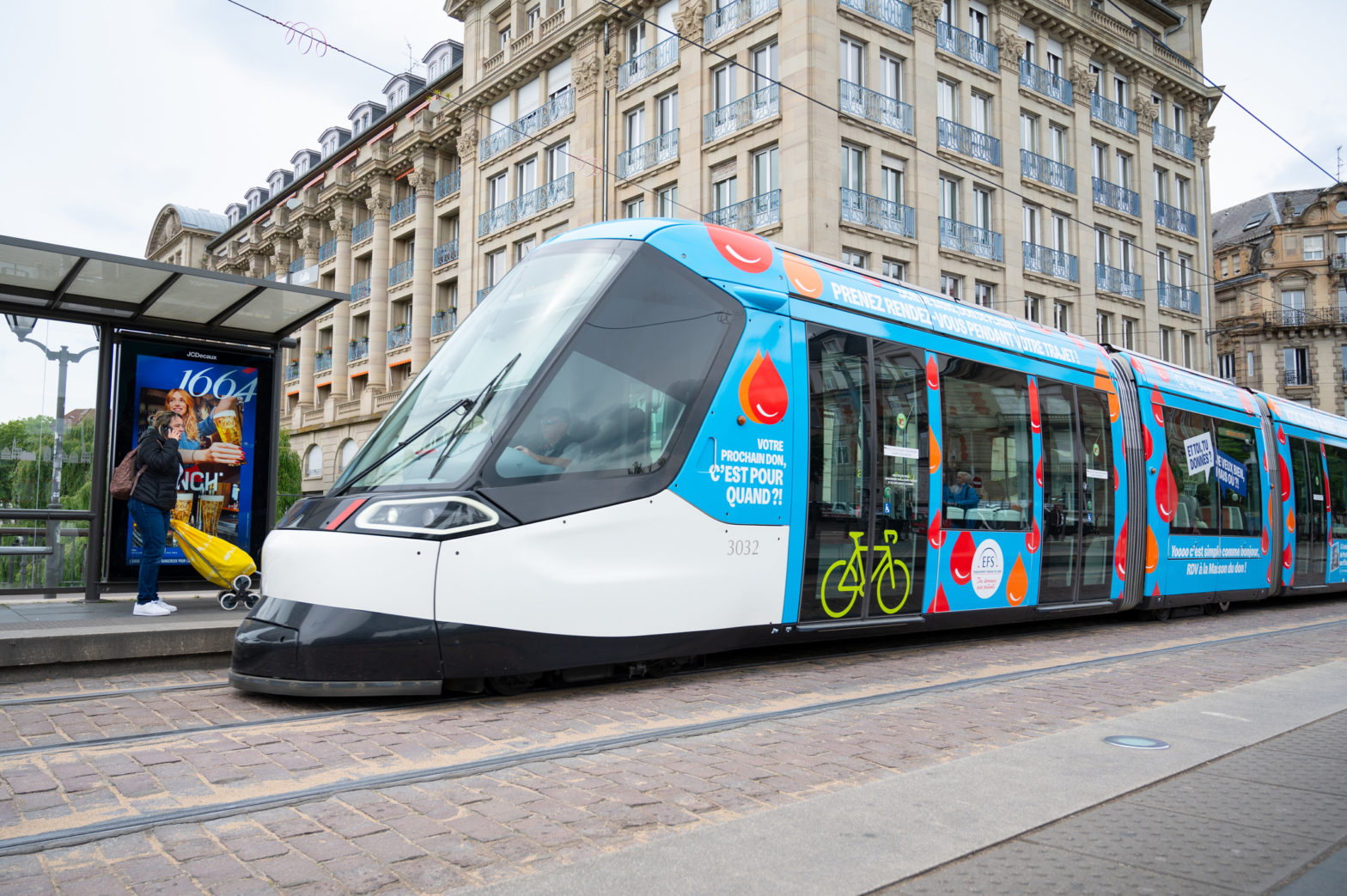
One of the closest examples took place in Strasbourg in 2024. La Poste, Alstom, the Eurométropole and public transport operator CTS transported around 100 Colissimo parcels at a time aboard a regular Line B tram.
The parcels travelled alongside passengers from Hœnheim Gare to Broglie station in the city centre, where they were transferred to a cargo bike for final delivery. The experiment reflected the three-stage model examined by researchers: taking parcels from a distribution centre to the public transport network, moving them across the city by transit and completing the delivery using a low- or zero-emission mode.
A more established example can be found in the Tokyo region. Nishi Tokyo Bus and Yamato Transport began testing parcel transportation on scheduled passenger buses between Akiruno and Hinohara in 2019. Available space inside buses was used for packages while the vehicles continued operating their normal passenger services.
The scheme entered regular operation in 2020 and was still operating in 2024. Although it serves a more rural environment than the dense city centres usually associated with Freight-on-Transit, its basic operating principle is the same: passengers and parcels travel on a shared scheduled service.
Applying that principle in larger urban areas would raise complicated design questions. Passenger and freight space could be shared inside an existing vehicle, or operators could create areas specifically for cargo.
“You can adapt the buses in order to share the space between passengers and cargo, or maybe you can adapt the buses even more interestingly by using some kind of trunks especially dedicated to the buses,” Delle Donne said.
The distribution of costs and benefits presents another challenge. Residents could benefit from fewer delivery vans entering the city but would also share the public transport system with freight. Logistics companies could use transit for a substantial section of a parcel’s journey but would have to reorganise their operations around fixed services.
“They will have to adapt their system, their schedules, to the bus schedules,” Delle Donne said. “Even for private companies, it’s not clear how they are going to be using this system.”
Cities would also have to determine the commercial and regulatory arrangements. Delle Donne said policymakers could consider discounts or other incentives for participating companies, decide whether operators should be charged for using the system, or introduce rules governing urban deliveries.
“There are a lot of points of discussion, and all this impacts, of course, on the public policymakers in the cities,” he said. “In the end, this is something where public policymakers should apply some rules on delivery in the cities.”
Delle Donne’s own research largely begins after these regulatory, commercial and technical questions have theoretically been resolved. It uses mathematical models to determine how an established Freight-on-Transit network could deploy its resources as efficiently as possible.
A 2023 paper in examined the strategic question of which public transport lines and stations should be incorporated into such a system. Research published in the European Journal of Operational Research in 2025 considered how to coordinate the three stages of the delivery journey.
“We have some buses with a given capacity, with a given timetable,” Delle Donne said. “We have some depots and we have some customers, and we want to know which is the best way of using this system and all these resources, for example by maximising the number of parcels that we can deliver per day.”
Researchers can base their models on the public transport network of a city and generate realistic demand points. The resulting problems can be extremely complex and may take a computer several days to solve without additional mathematical techniques. Delle Donne’s team studies the properties of the models to find more efficient ways of reaching solutions.
The work is partly intended to ensure that the operational knowledge is available if Freight-on-Transit progresses from individual schemes into a more regular component of urban logistics.
“When I first heard of this topic, my first impression was: this is crazy. This is not going to happen,” Delle Donne said. “Then I started working on this, and now I’m kind of convinced that at some point this is going to happen. It sounds quite futuristic, but it’s not actually. It’s something that should happen in the future. The best thing that we can do as researchers is to be prepared.”
Main image: Beritk | Dreamstime.com