

Photo: CityLAB2
How Berlin is using AI to simplify benefit applications
22 September 2026
by Jonathan Andrews
More than half a million people in Berlin receive some form of social benefit, including income, health or child-related support, yet an estimated 40 to 60 percent of eligible people across Germany never even apply.
“Applying for social benefits is actually a pretty big pain for residents but also for the caseworkers on the government side,” Ben Seibel, CEO, CityLAB Berlin tells Cities Today. “These forms are really long. The language is very bureaucratic, and the process is really slow.”
CityLAB Berlin, the Berlin Senate-funded public innovation laboratory, has taken it on itself to transform the application system because even when people overcome the initial barriers, their applications frequently require further work.
CityLAB says around 90 percent of initial applications for social benefits are incomplete or contain an error. Officials must then request missing documents or clarify answers, contributing to waiting times of between three and five months.
“This is for people in very difficult situations,” says Seibel. “They do not have much money, so waiting for months for social benefits is actually a huge problem.”
Digital forms are not necessarily the answer because moving the questions from paper to screen leaves the underlying challenges unchanged. Residents are still expected to interpret official terminology, establish which type of benefit they can claim, and put together the correct information.
CityLAB Berlin and Google.org, Google’s philanthropic arm, have been exploring whether agentic AI could provide a different route through that process. The two-year Beyond Forms project is developing an AI assistant that can identify relevant support, guide residents through an application and complete the required form.
Testing before implementation
CityLAB investigates emerging technologies and develops prototypes before the government considers putting them into operational use.
“The mission of CityLAB is to do some kind of early exploration of new technological concepts that, at a later stage, might be integrated into government,” says Seibel. “Government IT is usually pretty slow and pretty expensive, and the idea of an innovation lab is to have a kind of speedboat charting the path for the future.”
For Beyond Forms, the team examined existing application processes with the Berlin Senate Department for Labour, Social Services, Gender Equality, Integration, Diversity and Anti-Discrimination. It interviewed benefit recipients and caseworkers to identify where applicants struggled and what created unnecessary work for staff.
One finding was that residents were already using generative AI services such as ChatGPT for help. CityLAB saw risks in sharing sensitive personal data with a commercial platform, so the alternative was to develop an open-source prototype capable of being hosted by cities themselves.
Building around the resident
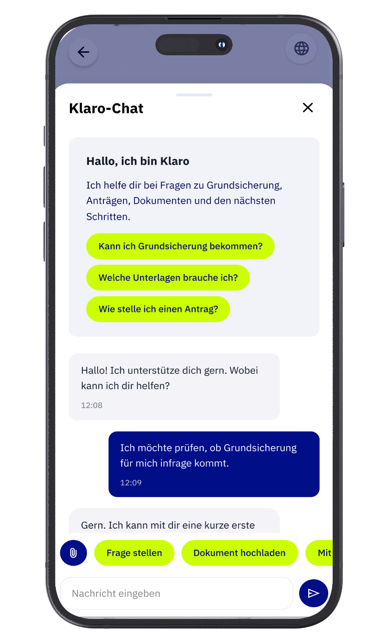 The prototype begins with an eligibility check so residents can establish whether they should apply for a particular benefit. A mobile-friendly conversational interface then gathers the information needed for the application.
Applicants can upload photographs of documents such as passports and rental contracts rather than copying every detail. AI-supported analysis extracts relevant information, while a guided questionnaire collects anything missing and a chatbot explains questions.
“It will ask you exactly those questions that are missing, and it will ask the questions in a way that is very easy to understand for users,” says Seibel. “You basically have a conversation, like: ‘Let’s have a look at your income. How much money are you making? Do you have a job? How much rent are you paying?’”
The AI uses the answers to populate the application, then presents the completed form to the resident for approval.
The team repeatedly tested early concepts with residents and caseworkers, while members of the public tried the prototype at CityLAB’s summer conference.
“We were constantly building and testing solutions to see what truly helps citizens, and then by powering this tool with AI, our core mission is to empower the users to fill out these forms faster and also with much greater accuracy,” says Nathalia Andrijic, Senior UX Researcher, Google.org Fellowship.
Starting with paper
CityLAB selected basic income support for older people as its first use case. Around 100,000 Berlin residents receive basic income support but the service chosen for the prototype had no digital application system. Applicants had to complete a paper form and send it by post.
Rather than viewing that as an obstacle, the team saw an opportunity to begin without connecting the prototype to a legacy platform.
“We thought this could be an easy way to leapfrog innovation because there was no digital system in place that we would have to connect with,” says Seibel. “Beyond Forms doesn’t care if there is a paper form. It will just fill out the form for you.”
The system can complete an existing PDF that the applicant then prints and submits, allowing it to help residents even when the public authority still depends on paper. CityLAB is adding other services so the assistant can help users identify appropriate support rather than assuming they already know which application they need.
Working with Google fellows
 CityLAB secured support by applying to the Google.org Fellowship programme.
“Through a Google.org fellowship, we provided a dedicated team of Google employees to support this shared vision pro bono for six months, and we supported CityLab with a US$1 million grant to continue the project,” says Marco Lohse, Senior Programme Manager, Google.org.
The interdisciplinary team included employees from Berlin, London and Zurich. Seibel says the fellows acted as a technical “sparring partner” as CityLAB explored how an AI agent should interact with residents, including older applicants.
The teams worked in development sprints and produced a first prototype and early open-source release during the six-month fellowship. CityLAB is continuing the project independently until the end of 2027.
Keeping people in control
Beyond Forms remains a research project rather than a finished public service. CityLAB is evaluating different AI models and how accurately they can interpret information and provide guidance.
“We do not have the final solution for privacy and also for correctness,” Seibel says. “We’re evaluating different kinds of AI models, for example, and how precise they can be.”
The system follows a human-in-the-loop approach. It can collect information, answer questions and prepare an application, but nothing is submitted without the applicant’s approval. Responsibility for official decisions remains with the public authority.
Although Google.org supported its development, the software is vendor-agnostic. A city could operate its own version in its own computer centre instead of relying on Google or another external cloud provider. Administrations could also upload their existing forms and use AI to convert them into a machine-readable format.
The same components could eventually support services beyond social benefits, such as parking permits. Charities that help people claim benefits could also deploy the system without accessing internal government systems.
For CityLAB, the decisive result would be real-world adoption. The next stages will test whether Beyond Forms can help more eligible residents apply, reduce errors and ease the workload for caseworkers.
“We hope to get these error rates down a lot,” says Seibel. “If forms have fewer errors, it’s also less work for government caseworkers. We hope in the end it’s a win-win situation: easier for citizens but also easier for caseworkers.”