Europe’s cities urge funding to deliver high-speed rail network
03 December 2025
by Eurocities
In November, the European Commission unveiled its plan for a pan-European high-speed rail (HSR) network, promising to shrink travel times, reduce greenhouse gas emissions, and boost local economies and European competitiveness.
Eurocities welcomes this long-awaited plan, which sets a major milestone for Europe’s green transition and echoes what cities have long been calling for: the development of a high-quality rail network to link all major European cities and urban centres.
Making rail the ‘go-to’ choice
A year ago, Apostolos Tzitzikostas, European Commissioner for Transport and Tourism, committed to presenting a plan for HSR by the end of 2025 to help connect EU capitals, including night trains and the acceleration of rail freight.
A little more than one year later, the plan has been announced. This Communication presents a clear roadmap and concrete measures to boost the shift from air and road travel to a well-functioning, faster high-speed rail network by 2040. Most notably, the plan aims to double high-speed rail traffic by 2030 compared to 2015 and triple it by 2050.
This is part of the EU’s broader agenda to prioritise sustainable and accessible transport through the European Green Deal, the Sustainable and Smart Mobility Strategy, and the revision of the trans-European transport network (TEN-T). Concrete progress has been made, for instance, with the €5.64 billion in railway investments under the latest Connecting Europe Facility (CEF)-Transport call.
Melanie van der Horst, Deputy Mayor of Amsterdam, explains why now is a crucial time for this shift: “In a time of global tensions, strengthening Europe’s rail network is vital for resilience, connectivity, and competitiveness. If we make international train travel faster, easier, and more accessible, it can become the go-to choice for millions of people, helping Europe reduce emissions and build a more sustainable future.”
The transition to rail boasts significant economic and environmental benefits. With transport accounting for 25 percent of the EU’s total greenhouse gas emissions, the climate impact of the transition to rail is considerable.
Rail is the most sustainable mode per passenger-kilometre and is expected to save 11.6 billion barrels of oil, corresponding to 5 billion tonnes of CO2 by 2070. The net economic benefits of enhanced proximity to and between economic hubs resulting from completing the HSR Network are estimated at around €750 billion.
Shrinking travel times bring cities closer together
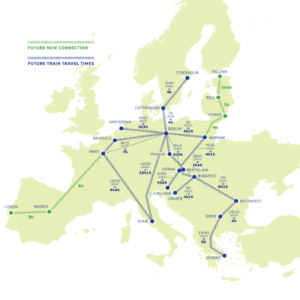
The plan promises to deliver major improvements for passengers. They can expect to see significantly reduced travel times along with faster, more comfortable and reliable rail services. Building on the TEN-T plan, it sets the bold ambition to cut the durations of several highly frequented rail journeys.
For example, it would slash three hours off the trip from Berlin to Copenhagen, from seven to only four hours. These reductions have real impacts on cities, bringing them closer together.
Quick transportation between European cities is crucial for economic and industrial development and the functioning of the internal market. By shrinking travel times, HSR fundamentally changes the perception of distance, empowering people to reach opportunities that may once have seemed too far to pursue.

“Our international economy relies on a steady supply of qualified workers,” says Melanie van der Horst. “International rail plays a crucial role in this: without strong connections to the European rail network, Amsterdam becomes less accessible to this vital workforce, which directly impacts our economic strength.”
As mentioned in the 2024 Letta Report on the state of the EU Single Market, the plan drives economic growth, supports sustainable transport, and strengthens EU integration by linking cities and regions. Shrunken travel times on corridors will boost demand for business and leisure travel.
Hanna Zdanowska, Mayor of Lodz, welcomes the announcement saying: “Construction of the coherent high-speed railway system in Europe will finally erase the difference between the ‘old’ and the ‘new’ Europe. Lodz is a million-inhabitant metropolis, in which our citizens, thanks to completing the HSR system, will be able to reach Prague, Berlin, Vilnius, and Lviv within a 3-hour journey.”
Turning positive intentions into concrete actions
Though the plan connects rail at the European scale, cities are critical hubs where the plan will be implemented on the ground. It is cities that are tasked with integrating long-distance rail into their local mobility networks through a combination of sustainable urban mobility plans and targeted investments.
Past large rail infrastructure projects have not always taken this important factor into account. Looking back on mega railway projects in recent history, it is clear that to be successful, local and regional governments must be involved from conception to completion. The Commission’s HSR plan, if complemented by concrete actions, could offer a solution to some of the challenges cities are facing.
Cities have a clear opportunity to position themselves as essential partners in corridor planning, station integration, and sustainable door-to-door journeys in the plan. The Commission’s plan makes clear references to capitals and major cities and urban nodes in Europe. City authorities are expected to play a key enabling role in connecting urban nodes to the TEN-T high-speed network, supporting multimodal access, and leveraging EU funding streams and they are up for the challenge.
Dávid Vitézy, Chair of the Committee for Transport, Climate Action and Urban Development in the Budapest City Assembly, shares his perspective: “For Europe’s high-speed rail network to succeed, our urban nodes must be ready to connect. In our cities throughout Europe, we’re investing in modernising stations, expanding capacity, and integrating long-distance rail with local mobility. But cities cannot do this alone. We join Eurocities in calling for continued and stronger EU and national investment in urban nodes.”
While many aspects are encouraging, cities expect these positive intentions to be turned into concrete opportunities to be included in the discussions on the implementation of the plan.
As part of the European Week of Regions and Cities, Eurocities and the Community of European Railway and Infrastructure Companies (CER) organised an event in the European Parliament, leading to the direct handing out of our joint Declaration on Connecting Europe at High Speed to Commissioner Tzitzikostas.
The CER-Eurocities Joint Declaration calls for the EU to develop:
- A viable and coherent European HSR network that connects all EU capitals and major cities, through integration with lower-speed networks, flexible operating models, and investment in stations, rolling stock, and service capacity.
- Long-term, sustainable funding combining public and private investments to meet the estimated €546 billion needed by 2050. Investments should also focus on improving the integration between long-distance and local mobility services within urban nodes, reinforcing Eurocities’ call to maintain the references to urban nodes in the 2027 CEF Transport.
- Seamless and passenger-friendly ticketing system to compete with air travel. Cooperation with local governments is needed to ensure that tickets for local transit legs of longer journeys are easily accessible to users during the planning stage.
- A level playing field with other transport modes, through reforms to align energy taxes and address uneven coverage of infrastructure cost and externalities.
Melanie van der Horst expresses her hope for the plan. “The EU has a unique opportunity to make international train travel a real alternative to flying, something that directly benefits both travellers and communities across Europe,” she states. “Travelling by train emits up to 75 percent less CO₂ than flying and is far more comfortable. For travellers, this means fewer delays, easier ticket booking, and faster connections between cities and regions.”
Ready to join the call for a more connected Europe?
The CER-Eurocities joint declaration is now open for individual signatures from city mayors and rail CEOs across Europe. Join the more than 30 signatories who have already made their voice heard in the declaration.
Read the full declaration and get involved here.
*This article was originally published on Eurocities